Can AI Sex Chat Help With Loneliness? A Measured Look
The honest answer sits between the marketing and the dismissal. A text conversation can occupy a specific kind of evening and can be easier to start than contacting a friend, but it is not human company and it is not treatment for anything. The counters keep the claim grounded: on the three leading cards, each favourite arrived alongside roughly 3,400 to 6,800 views.

Key takeaways
- A chat can fill a window of time and give you somewhere to think out loud; that is a real but limited benefit.
- It cannot meet real-world needs, and no published wording from the platform claims it can.
- Watch the numbers: 19.1M views producing 2.8K favourites means most readers do not return, which is worth knowing before expecting more.
- The useful test is displacement. If sessions replace contact you value, the habit is working against you, not for you.
What a text conversation can reasonably do
Start with the modest version, because it is defensible. A chat gives you a place to write without social cost: no scheduling, no obligation to keep the conversation going, and no lasting embarrassment if a sentence lands badly. For an evening when you want to talk and do not want to arrange anything, that is genuinely useful, and it is available at the hours when arranging anything is hardest.
It also gives structure. Writing a scene, choosing how a character responds, and continuing the thread the next day is an activity rather than a feed, and activity of any kind tends to be better company than passive scrolling. The platform describes companions that adapt to your personality and remember your preferences, which is what makes the second session different from the first.
What it cannot do
It cannot respond to your actual circumstances. A character can be written as thoughtful, but it does not know that you missed a deadline, that a friend moved away, or that the boiler is broken, unless you type it. Nothing in the exchange can act on any of it. That gap is what separates a text habit from a relationship, and it is not a flaw in the product; it is the boundary of the medium.
It is also not a treatment. There is no clinical claim here to evaluate, and readers should be sceptical of any article, including this one, that implies a chat platform addresses a health condition. What the platform does say is narrower and accurate: the content is AI-generated text, it depicts no real person, and its pages exist for adults. If the feeling you are trying to manage is persistent, that conversation belongs with people, not with software.
| Claim you may read | Reasonable reading | Where it goes too far |
|---|---|---|
| A companion is always available | A chat window opens at any hour without arranging anything | Suggesting availability substitutes for presence |
| It adapts to you | Replies reflect preferences and earlier scenes | Implying the system understands your situation |
| It helps loneliness | It occupies time and provides a low-pressure space to write | Framing it as support for a persistent condition |
| It is private | The platform describes a private and secure environment | Turning that into a promise of invisibility |
Worked example
The counters are useful because they express how the average reader behaves, which is a useful counterweight to any confident claim. Card A: 24.3M views divided by 7.1K favourites is about 3,423 views for every favourite. Card B: 19.1M divided by 2.8K is about 6,821. Card C: 18.2M divided by 4.7K is about 3,872.
Read that as intent rather than satisfaction. Somewhere between one in three thousand and one in seven thousand readers decided a card was worth returning to, while everyone else read briefly and left. That is normal for any large catalogue, and it is also the reason to be cautious about testimonials: the readers who found something in the format are a small minority of those who tried it. If you try it and it does not fit, you are in the larger group, and that is an ordinary outcome rather than a personal failure.
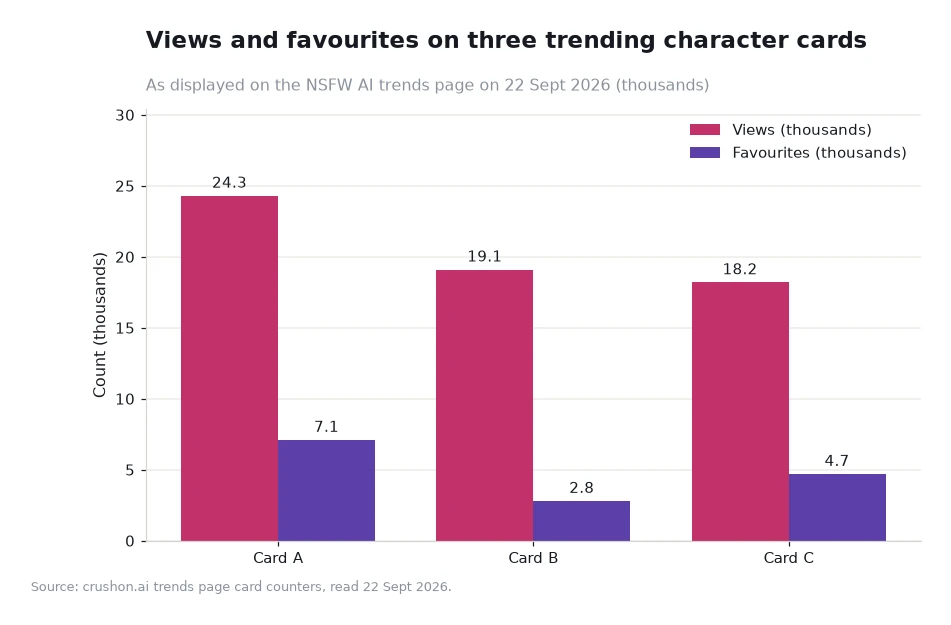
It is worth separating two questions that often arrive together. The first is whether a chat is enjoyable, which is a matter of taste and entirely answerable by trying it. The second is whether it is doing something for your wellbeing, which is a much larger claim than any text product supports, and the honest position is that it can occupy a difficult evening without addressing the reasons the evening was difficult.
Testing it against your own week
The practical way to decide is displacement. For two weeks, note one line before and after each session: what you felt like opening it, and what you felt like closing it. Then compare the total time against the things it took the place of. If sessions have replaced scrolling, the trade is probably a good one. If they have replaced calls, walks or meetings with people you like, the arithmetic is going the wrong way, and the answer is not to change the platform.
Read the platform's own account before drawing conclusions about what it promises. Crushon's ai sex chat page describes Sex AI companions that adapt to your personality and remember your preferences, and the wording stays within what a text product can deliver: responsive, private, adult. There is no claim about wellbeing anywhere in it, which is precisely why it can be read straight.
Two small habits keep the picture accurate. Protect one recurring social commitment in the week and treat it as fixed, so a session can never quietly consume it. And if you notice the habit growing to fill evenings rather than windows, cut it back for a fortnight and see what changes; the point of measuring is to keep the choice deliberate. The AI chat blog is a reasonable place to read how the format is described, and the character search page is where you can test whether a more specific register suits you better than the popular cards did.
Frequently asked questions
Is using a chat platform a sign of a problem?
No. The useful signal is displacement — whether sessions are crowding out contact you value — rather than the habit itself.
Can a companion replace a friend?
It cannot. A character responds to what you type and cannot act in your life, which is the whole difference between a text exchange and a relationship.
How soon will I know whether the format suits me?
Two weeks of short sessions is usually enough. A single evening rarely distinguishes a good fit from a novelty.
Measure it, then decide
Keep the claim narrow: a chat can make an evening easier to get through, and it cannot do more than that. Try it for two weeks, note how you feel at the start and end of each session, and check what it displaced. The platform's own description is narrow enough to be taken at face value, which makes your own measurement the only test that matters.
Sources: the trends page card counters and the client's AI sex chat wording, both read 22 Sept 2026[1]. Views-per-favourite figures are arithmetic on those counters, not survey data. Read 22 Sept 2026. For adults only: this piece is written for readers aged 18 or above.