Frost Stars as a Payment Rail, Not a Discount
Frost Stars convert at face value in Whiteout Survival — the published example is a $9.99 pack that costs 999 Frost Stars — so a dollar put in comes back out as a dollar of pack. Buying the tokens first therefore changes nothing about the price you pay; the only savings on the table come from what keygold.gg charges for the pack itself. The ANY 9.99 tier is listed at $8.15, and that $8.15 is where the whole story sits.

Key takeaways
- Face value is the published rule: a $9.99 pack costs 999 Frost Stars, so 100 tokens are worth one dollar.
- The ANY 9.99 pack is listed at $8.15, and the markdown sits on the pack rather than on the token.
- KeyGold buys the pack itself inside the account and does not sell Frost Star top-ups.
- An account-login order can reach limited-time gift packs, Monthly Cards and personalised offers that a UID top-up cannot.
What a face-value token can and cannot do
The useful way to think about Frost Stars is as a rail rather than as a product. Value travels along the rail unchanged: 999 Frost Stars buy a pack that is priced at 999, which is why the site's own wording is that a dollar in becomes a dollar of pack out. Nothing about holding the tokens, buying them earlier or buying them in bulk changes the number of dollars they represent at the counter.
That is not a drawback; it is a description of the mechanism. Where the saving comes from is the price at which the pack is offered, and that price is published beside the in-game figure on the Whiteout Survival page. Home-page discount for this title is 18%, and the individual pack listings are where that percentage either does or does not show up.
There is a second difference worth spelling out, because it separates Whiteout Survival from a UID-based top-up. When the order is placed as an account login, the buyer is not limited to currency: the pack itself is bought, which means limited-time gift packs, Monthly Cards and personalised offers are all reachable. Those items are offered inside the account, and a UID top-up has no way to see them, since it never opens the shop.
The published ANY pack ladder, with the token value beside it
The ladder below is taken from the client's own page. The third column is the arithmetic of the published face-value rule, where 100 Frost Stars equal one dollar and the page's own example is the $9.99 tier at 999 Frost Stars. It is included so the two numbers can be compared at a glance rather than converted in the head.
| Pack tier | Price on keygold.gg | Frost Stars in the pack |
|---|---|---|
| ANY 0.99 pack | $0.82 | 99 |
| ANY 9.99 pack | $8.15 | 999 |
| ANY 49.99 pack | $40.79 | 4999 |
| ANY 99.99 pack | $85.99 | 9999 |
Worked example: buying the tokens first, then the pack
Here is the question the rail metaphor answers. Take the $9.99 tier and walk through both routes with the published figures only: the pack costs 999 Frost Stars at face value, and the ANY 9.99 listing on the store is $8.15. The arithmetic is the author's; the inputs are all from the page.
Route one, tokens first. Buy 999 Frost Stars worth of value at the published rate of 100 per dollar: 999 ÷ 100 = $9.99 of face value. Pay the store's listed $8.15 for that tier, then spend the 999 Frost Stars on the pack that costs 999. Total spent: $8.15, and the pack costs $9.99 inside the game. The saving of $9.99 − $8.15 = $1.84 was on the listing, not on the token.
Route two, the pack directly. Order the same tier as a pack purchase in the account and pay $8.15. Total spent: $8.15. The two routes end at exactly the same figure, because the token passed through at face value in between. Ordering the tokens first is not wrong — it simply adds a step without adding anything to the result.
One further division is worth doing, since it shows how the published discount behaves across the ladder. On the 0.99 tier the store lists $0.82 against a face value of $0.99, a difference of $0.17, which is about 17% of the face value. On the 99.99 tier the listing is $85.99 against $99.99, a difference of $14.00, or 14% of face value. The home page summarises the title at 18%, and the individual tiers bracket that figure rather than repeating it exactly — which is why the pack you actually want is the one to price.
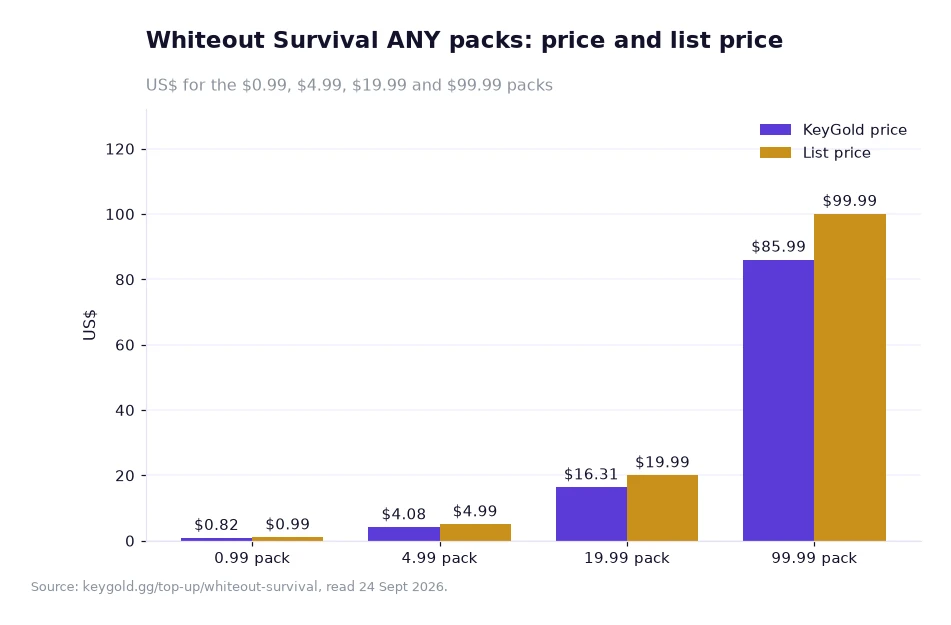
How the chart draws the ANY ladder
The chart takes four rungs of this game's own ladder and draws each one twice, which is the clearest way to see where the token sits in the transaction. The 0.99 tier is plotted at $0.82 beside a list price of $0.99, the 4.99 tier at $4.08 beside $4.99, the 19.99 tier at $16.31 beside $19.99, and the 99.99 tier at $85.99 beside $99.99. In every pair the left bar is the store's charge for the pack and the right bar is the pack's list price, and the difference belongs to the pack rather than to the Frost Stars used to pay for it.
Read that against what was established above and the argument closes. A markdown on a pack is a price reduction on a product. A face-value token has no equivalent, because the token is not the product — it is the money used to buy it. Anyone who tells you tokens bought in advance quietly grow is describing something the client's own pages do not say.
A reader looking for a whiteout survival frost star buy will find the pack ladders rather than a token shop, and that is by design: the account-login route exists precisely so the pack can be bought inside the game where the offers are. The top-up index lists the other titles that work the same way, with the same pair of prices printed on every pack.
Login details and delivery after payment
Whiteout Survival orders need the login method the player actually uses — Facebook or Google — together with the account and the password. That is a shorter list than most titles require, and it is deliberate: those are the credentials the game itself accepts, so the session opened for the purchase looks like any other session on the account.
Once payment is confirmed, the published delivery window is usually 10 to 30 minutes, and the page notes that the store buys the pack itself inside the account. During that time the account should be left alone, and afterwards the password should be changed, with two-step verification kept reachable so a prompt can be answered if one appears. The Full Refund Guarantee published on the page covers an order that is not delivered or cannot be used.
Status is never a mystery in the meantime. The Order Record on the account shows where an order stands, the confirmation email arrives when it completes, and the live chat is staffed 24/7 if something needs asking rather than checking.
Frequently asked questions
Should I buy Frost Stars before the pack, or with it?
It makes no difference to the total. Frost Stars convert at face value, so 999 of them buy a pack priced at 999, and the store's listing price for that tier is what you pay either way — $8.15 on the ANY 9.99 pack at the time of reading.
Does an account-login order reach offers a UID top-up cannot?
Yes. Because KeyGold buys the pack itself inside the account, limited-time gift packs, Monthly Cards and personalised offers are all reachable. A UID top-up never opens the shop, so those items are outside its scope.
Where the saving actually comes from
Every number in this article is a published price for a pack, and the discount is applied at exactly that point. The rail that carries the value — Frost Stars — is neutral by design, and that is good news rather than bad: it means there is no timing trick to learn, no optimum month to buy tokens in, and nothing to hold in the account waiting for a better rate. The help center spells out the account-login procedure if the details above are not enough.
Pick the pack that matches what you were going to spend anyway, check the two prices printed beside it, and leave the token question alone. That is the entire decision, and the published ladder makes it a one-minute one.
Figures in this article come from the client's own pages on keygold.gg — the Whiteout Survival top-up page and the home page — read 24 Sept 2026[1]. Prices are shown in USD; where a reader's own currency is involved, a bank may add its own conversion fee. The comparisons between listed prices and face values are the author's arithmetic on published numbers and are examples, not forecasts.