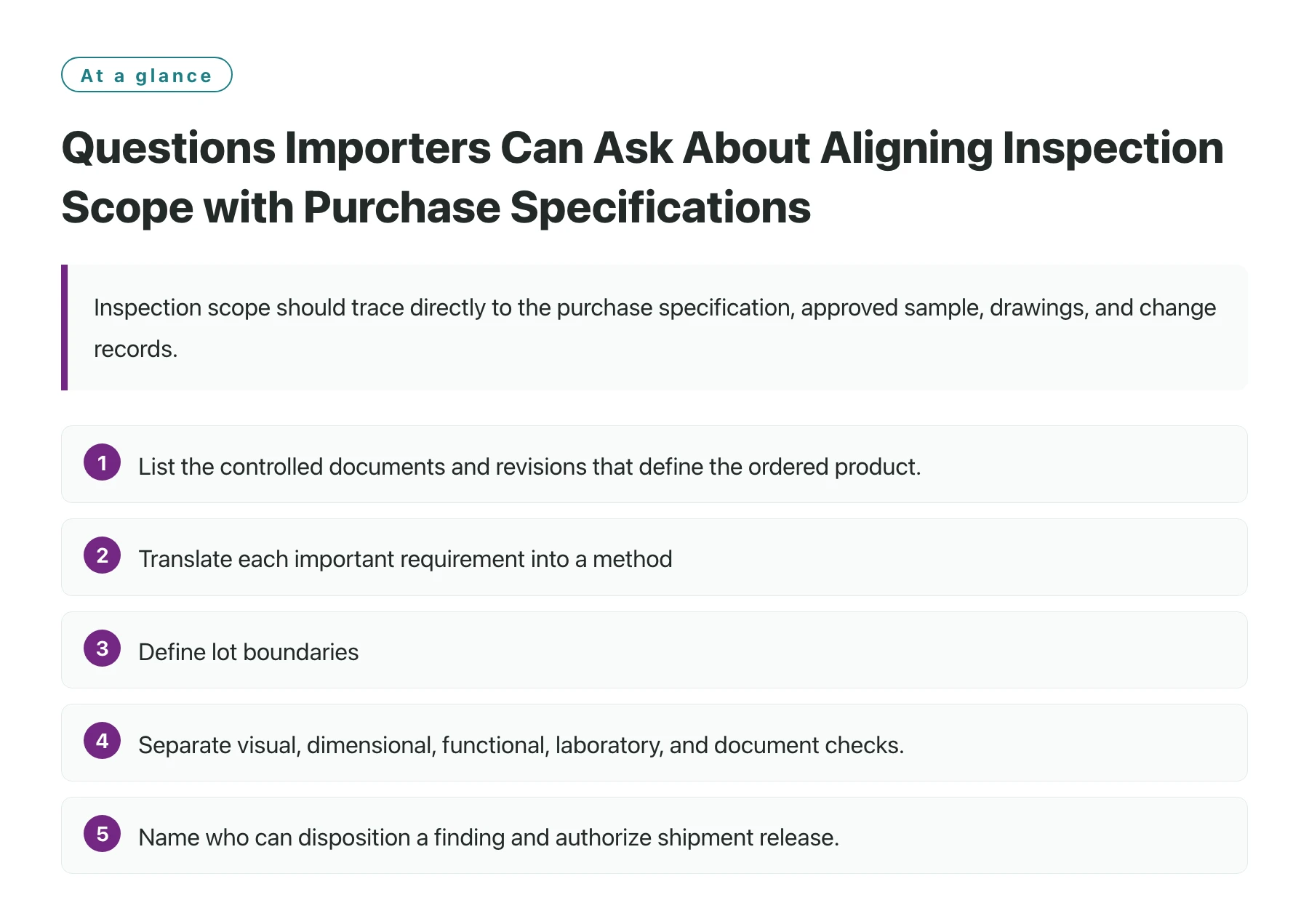
Inspection scope should trace directly to the purchase specification, approved sample, drawings, and change records. Before goods are checked, importer and supplier need to agree the lot, sample method, test procedures, acceptance criteria, defect categories, and decision authority. Without that alignment, an inspection report can be detailed yet answer a different question from the one the buyer needs to decide whether to accept, rework, or release the order.
Key takeaways
- List the controlled documents and revisions that define the ordered product.
- Translate each important requirement into a method, evidence, and acceptance rule.
- Define lot boundaries, sample selection, and any attribute sampling plan in advance.
- Separate visual, dimensional, functional, laboratory, and document checks.
- Name who can disposition a finding and authorize shipment release.
Use the inspection plan as a bridge between contractual requirements and evidence collected on the factory floor.
1. Which documents define the requirement?
Begin with the purchase order, technical specification, drawings, bill of materials, approved sample, packaging instructions, and change notices. List the revision and approval date of each document. Identify which document controls if two versions conflict. Do not ask an inspector to infer a tolerance from a marketing brochure or decide whether an old sample overrides a current drawing.
Create a requirement crosswalk with clause or drawing reference, product or variant, inspection stage, method, acceptance rule, and report field. Separate mandatory contractual requirements from preferences. If a dimension, finish, or function has no defined criterion, ask the buyer’s technical owner to resolve it before inspection rather than introducing a new criterion during the visit.
2. What does each inspection stage cover?
Decide whether the plan covers incoming materials, first production, in-process work, finished goods, packaging, or loading. Each stage can reveal different issues. A pre-shipment inspection may establish visible condition and agreed sample checks at a specific time; it does not automatically prove process control, legal compliance, or performance over the product’s full service life.
State what is outside the visit, such as destructive testing, chemical analysis, certification validation, or engineering evaluation. If one of these is required, assign a suitable laboratory or specialist and link the result to the same product and lot. Explicit limits prevent a “passed inspection” label from being read more broadly than the evidence supports.
3. What is the lot and how will samples be selected?
Define the inspection lot by product, production date, plant, model, quantity, and any other factor that affects consistency. Explain how goods are grouped when colors, sizes, batches, or suppliers differ. Agree whether the inspector selects samples randomly from available finished goods, from opened cartons, or by a specified stratified method. State what happens if the lot is incomplete or not accessible.
If the parties use ISO 2859-1:2026, specify the exact sampling scheme and related choices in the contract or inspection agreement. The standard addresses AQL-indexed sampling schemes for lot-by-lot inspection by attributes; the buyer still needs to select an appropriate plan and define product requirements. AQL is not a promise that every uninspected item conforms or a universal acceptable defect percentage. [1]
4. Which methods and instruments are appropriate?
For every check, specify the method, sample identity, units, equipment, calibration expectations, environmental conditions, and result format where relevant. A measurement should cite the drawing feature and tolerance. A function test should state the operation and pass condition. A visual review should define lighting, viewing distance, and defect examples when appearance matters.
Separate observation from test results. A photo can document a scratch or label but cannot establish internal composition or a material property. A factory certificate may provide context but does not replace an order-specific measurement. When the method needs technical expertise, identify who performs it and who interprets results before scheduling the inspection.
5. How will defects and failures be classified?
Agree defect categories and examples using the project’s risk and product type. State whether an issue is critical, major, minor, cosmetic, functional, or otherwise classified by the buyer’s plan. Avoid relying on a generic table if the purchase order has a more specific safety or performance rule. Define how repeated instances, rework, mixed lots, and damaged packaging are counted.
For each failure, require requirement reference, observed result, sample or unit ID, photo or measurement, quantity affected, and immediate containment. If an acceptance plan uses accept and reject numbers, list the selected plan and how the decision is calculated. Do not let the inspector substitute a personal preference for the buyer’s agreed criteria.
6. Who receives and interprets the report?
Name the buyer contact, supplier contact, inspector, technical reviewer, and final decision owner. Agree the report deadline, urgent notification route, and format. For a potentially serious issue, require prompt escalation before the full report is compiled. State whether the inspector may request sorting or a pause, and who has authority to issue a formal hold.
Require the report to identify scope, documents reviewed, sampling method, limitations, tested quantity, results, open questions, and evidence links. A report should distinguish “not checked,” “not available,” and “not applicable.” If translation is involved, retain the original observations and ensure that technical terms preserve the meaning of the requirement.
7. What happens after a nonconformity?
Define the path for containment, rework, replacement, concession, rejection, and reinspection. Record who proposes an action, who approves it, and which affected quantity it covers. A deviation should name the requirement changed, commercial impact, technical rationale, evidence, conditions, and approval date. Do not treat a supplier’s corrective-action promise as completed verification.
Set rules for reinspection: who selects the new sample, whether the full lot or repaired units are checked, what evidence is required, and how costs are allocated. Keep the original result and follow-up result connected. Shipment release should be a distinct recorded decision after critical issues and required documents are closed.
8. Keep scope aligned when the order changes
When product, material, factory, quantity, packing, or drawing changes, assess whether the inspection plan still applies. Update the order documents and checklist together. Tell the supplier and inspector which revision is effective and whether prior sample approvals remain valid. For split shipments, identify each lot and avoid carrying acceptance from one batch over to another without a stated basis.
Review results after delivery to see whether the planned checks caught relevant problems and whether the requirements were clear. Adjust methods and evidence fields based on actual nonconformities, not habit alone. Importers arranging product quality checks in China can use a shared crosswalk to connect purchase specifications, factory instructions, inspection records, and release decisions.
Sources
Frequently asked questions
Can an inspector decide what the purchase specification means?
The buyer’s authorized technical owner should resolve ambiguity. The inspector can document the conflict and evidence, but should not invent missing limits or revise the contract in the field.
Does a passed sample inspection approve the full production lot?
Only to the extent stated by the agreed method and sample plan. Record lot definition, sample selection, checks, limitations, and separate controls needed for untested requirements.
Is AQL the same as a percentage of acceptable defective products?
No. It is part of a defined attribute sampling scheme with lot and decision rules. Select the plan deliberately and define critical product requirements separately.
Who should approve shipment after a failed check?
The named release authority should review evidence and open findings, then record rejection, rework, replacement, or an authorized deviation before shipment proceeds.