What a 500 Litre Brewing System Can Produce in a Week
A 500 litre brewhouse is not the limit on weekly output; the fermentation tanks are. With eight 500 L tanks and a 14-day residency the tank side allows about four brews a week, which is roughly 2,000 L gross and about 1,840 L packaged once an assumed 8% loss is taken off.
Key takeaways
- A 500 L turn is about 4.3 barrels, using the brewing convention that 1 BBL is roughly 117 L.
- Fermenter count divided by residency in days, multiplied by seven, gives the sustainable brews per week: eight tanks at 14 days is four brews a week.
- Assume 8% total loss between the kettle and the keg, split between trub, fermenter bottoms and packaging, and the four brews leave about 1,840 L packaged.
- Hermann publishes 500 L as one of its microbrewery sizes, alongside 300 L, 1,000 L, 2,000 L and larger vessels, so the same room can grow a step at a time.
The Kettle Sets the Batch, the Tanks Set the Week
A brewhouse is a batch machine, not a continuous one. A 500 L vessel set puts about 500 L of wort into a fermenter each time it is fired, and how often it can be fired depends on two things: how long a brew day takes and how many tanks are waiting to receive the wort. Selling a keg a week is a kettle question; selling forty is a tank question, which is why the fermenter count appears in every capacity plan before the brew length does.
This is the point at which buyers move from a home-scale mindset to a commercial one. The published micro brewery equipment range starts at sizes that fit a restaurant and runs through 1,000 L, 2,000 L and 5,000 L vessel sets, with the piping, the pumps and the control cabinet scaled to match. Picking the size is easier once you know the weekly number you are aiming at, because everything downstream is sized from that figure.
Turning Litres Into Barrels Without a Calculator
Most brewery business plans get argued in barrels and designed in litres, so it pays to hold one conversion in your head: 1 BBL is about 117 L, which makes 1 hectolitre exactly 100 L. A 500 L brew is therefore a little over 4.3 barrels, a 1,000 L brew is about 8.5 barrels, and the largest published size in this family, a 10,000 L (10 T) system, is roughly 85.5 barrels per turn.
The same conversion runs in the other direction when you are reading somebody else's plan. An 18,000 barrel a year figure, the kind used to describe a microbrewery ceiling, is about 2.1 million litres a year, which is a very different room from the one that holds a 500 L kettle. Do the conversion before you compare any two projects, because barrels flatter small plants and litres flatter large ones.
Where the Volume Disappears Between Kettle and Keg
Not every litre boiled reaches the customer. Assume 6% is lost in the kettle and the fermenter, through trub, hops and the yeast cake at the bottom of the cone, and another 2% is lost at packaging through line losses, foam and the last keg that does not fill. That is 8% in total, a planning figure rather than a promise, and it is the number that turns gross brewhouse volume into a sales forecast you can trust.
Loss compounds the other way too. If the tank is filled to the brim there is no headspace for the krausen, and a blow-off through the CIP arm sends beer down the drain, usually on the batch you were counting on. Sizing the fill at about 80% of the vessel, leaving the rest as working headspace, is a plain way to avoid buying litres twice.
How Tank Count Changes the Weekly Number
The sustainable brewing rhythm is simple arithmetic: tanks divided by residency in days, multiplied by seven. Eight 500 L tanks with a 14-day schedule gives 8 / 14 x 7 = 4 brews a week. Six tanks at the same residency gives 3 brews a week, and twelve tanks gives 6, which is where the brewhouse itself becomes the constraint rather than the cold room.
Residency is a decision as much as a measurement. A seven-day ale schedule needs half the tanks of a fourteen-day schedule for the same weekly volume, at the cost of a faster, warmer ferment and a beer with less conditioning time. Lager pushes the other way: a two to three week residency means more tanks for the same output, so the honest way to choose between two sizes is to fix the residency first and count the tanks second.
| Published size | Litres per turn | Barrels per turn (own conversion) | Gross litres per week at four brews |
|---|---|---|---|
| 200 L nano brewery | 200 | 1.7 | 800 |
| 500 L microbrewery | 500 | 4.3 | 2,000 |
| 1,000 L | 1,000 | 8.5 | 4,000 |
| 2,000 L | 2,000 | 17.1 | 8,000 |
| 5,000 L | 5,000 | 42.7 | 20,000 |
| 10,000 L (10 T) | 10,000 | 85.5 | 40,000 |
Worked example
The figures below are a worked example, not a quotation. Assumptions: a 500 L vessel set, eight 500 L fermenters, a 14-day residency for an ale and a lager mixed schedule, 8% total loss, filling into 50 L kegs, and fifty brewing weeks a year to allow for holidays and maintenance.
Tank arithmetic first: 8 tanks / 14 days x 7 = 4.0 brews a week. Gross volume: 4 x 500 L = 2,000 L. Packaged volume after the assumed 8% loss: 2,000 x 0.92 = 1,840 L. In kegs: 1,840 / 50 = 36.8, so 36 full kegs and a part keg from a week of brewing. Annualised at fifty weeks: 1,840 x 50 = 92,000 L, which is 92,000 / 117 = 786 barrels a year, or about 920 hectolitres.
Now check the kettle against the tanks. A single brew day is assumed to take six hours with cleaning, so five brew days a week fit comfortably inside one 30-hour working week, and even the four-brew rhythm leaves one free day for maintenance or a second product. That spare day is the difference between a kit that is working at its ceiling on day one and a kit with room to grow; the same brewhouse serves 6 brews a week if the tank count rises to twelve.
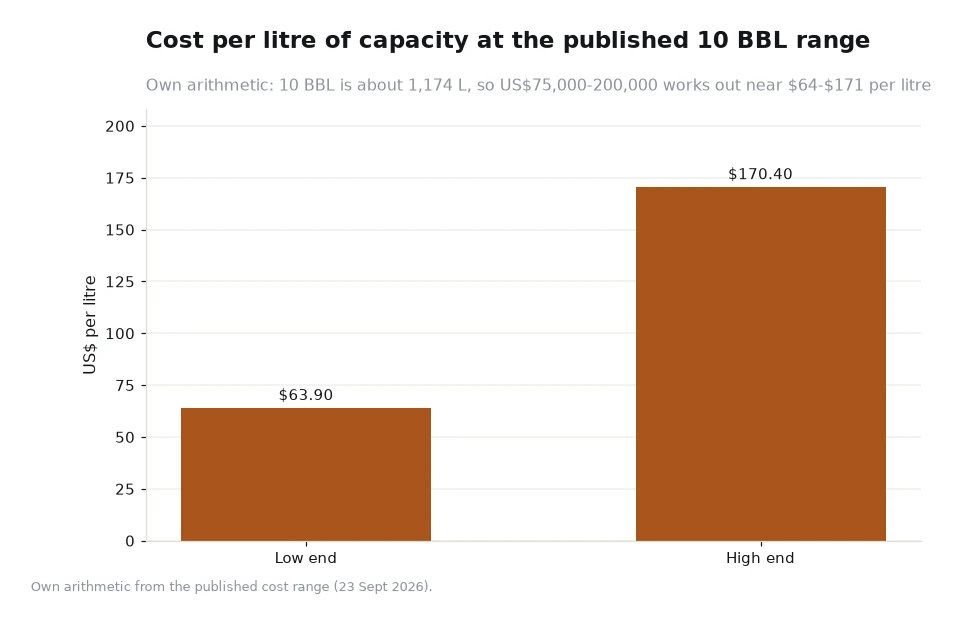
Capex per litre is where a small system shows its cost structure. Take the published 10 BBL example, which is 1,174 L of brew length, and divide the range by it: 75,000 / 1,174 = US$63.9 per litre at one end, 200,000 / 1,174 = US$170.4 at the other. A 500 L set costs far less in total, but its cost per litre of capacity is usually higher, because the pumps, the platform, the control cabinet and the heat exchanger do not shrink in proportion to the vessels.
Frequently asked questions
How many litres a week can a 500 litre system produce?
The fermenter count decides it rather than the kettle. Eight 500 L tanks with a 14-day residency allow about four brews a week, so roughly 2,000 L gross and about 1,840 L packaged after an assumed 8% loss. Add tanks and the same vessel set supports six brews a week; the kettle is rarely the constraint.
Is a 500 litre brewhouse big enough for a commercial taproom?
At four brews a week and fifty working weeks, a 500 L set works out near 92,000 L a year, about 786 barrels, which suits a taproom with a modest wholesale book. Once wholesale becomes the main channel, the published 1,000 L and 2,000 L sizes move more beer per brew day without needing a second building.
Sizing the Room Around the Weekly Number
Write the target weekly volume on one line, convert it to litres, divide by the brews per week you can actually run, and the brew length falls out of the arithmetic. Then count the tanks that the residency demands, and check that the room, the chiller and the floor drain can carry them.
Read the company background before you shortlist, since twenty-three years of design work in more than seventy countries leaves a useful trail of configurations, and send the contact page a plan of your room with the weekly target attached.
One last piece of discipline: keep the growth path in the first conversation. If a 500 L set is today and 1,000 L is three years away, the pump sizes, the pipe diameters and the electrical supply chosen now decide whether that step is a swap or a rebuild. Asking about the next size up costs nothing and saves a wall.
Published figures in this article come from the manufacturer's own website (hembrewing.com), read 23 Sept 2026: the system sizes, the five shipment inspection steps and the 6-year warranty on tank accessories and electronic components against manufacturing defects. All volumes, losses and cost-per-litre figures are the author's own labelled arithmetic.[1]