Why 800-Volt Platforms Suit Australian Road Trips
Australian distances punish slow charging more than they punish range. A car that adds 10% to 80% of charge in 12 minutes turns a highway stop into a coffee break, and that is the promise of an 800-volt architecture. The New G6 and the X9 both run a full-domain 800V silicon-carbide platform, and both publish the same 12-minute rapid window.
Key takeaways
- Both the New G6 and the X9 use a full-domain 800V high-voltage silicon-carbide platform.
- The 5C battery publishes 10-80% in 12 minutes; WLTP range reaches 525 km in the G6 and 580 km in the X9.
- Higher voltage means less current for the same power, which is the engineering reason the stops stay short.
- Plan on Type 2 and CCS2 public charging, with the flap on the right rear quarter panel.
What 800 volts actually changes
Power is voltage multiplied by current, so a higher-voltage pack delivers the same power with less current flowing through the cables. Less current means less heat generated in the wiring and the connector, and heat is the limit that forces most cars to slow down partway through a rapid charge. That is the practical case for 800 volts: not a bigger battery, but a battery that can accept a large amount of power for longer before it has to ease off.
The manufacturer describes the hardware as a full-domain 800V high-voltage silicon-carbide platform, with silicon-carbide semiconductors used because they waste less energy as heat than conventional silicon. In the G6 the same pages headline 5C supercharging and an Australian first for a 5C AI battery. The numbers that come out of it are a 10-80% state of charge window in 12 minutes and, in a separate internal test of the RWD Long Range version, up to 427 km of charge added in 15 minutes.
Two cars, one platform, different jobs
The platform is shared, but the vehicles built on it are not interchangeable. The New G6 is a coupé-style five-seat SUV with a fastback silhouette and a long front overhang; the X9 is a seven-seat MPV with active rear-wheel steering, dual-chamber air suspension and an AI chassis that reads the road up to 30 m ahead and adjusts damping before you reach the bump. For a driver weighing a long commute against a large family, the choice is about seats and shape rather than about charging speed.
Both are described as backed by Euro NCAP five-star safety, and both are covered by the same published ownership terms: whole vehicle warranty of seven years or unlimited kilometres for private use, key parts of eight years or 160,000 km covering traction battery, battery management system, drive motor and intelligent power unit, and scheduled servicing every 12 months or 20,000 km. A road-trip car has to survive a lot of highway kilometres, so those limits matter as much as the charging curve.
| Measure | New G6 | X9 |
|---|---|---|
| Platform | Full-domain 800V SiC | Full-domain 800V SiC |
| WLTP range | Up to 525 km | Up to 580 km |
| 10-80% charge | 12 minutes | 12 minutes |
| 0-100 km/h, AWD | 4.13 seconds | 5.9 seconds |
| Seats | Five, coupé SUV | Seven, MPV |
Where the plug goes, and what it accepts
Charging hardware aside, the day-to-day detail is the same for both cars. The charge flap sits on the right rear quarter panel and releases when you press the top-left corner, and the cars are compatible with most public Type 2 (AC) and CCS2 (DC fast) chargers. Some Tesla Supercharger sites in Australia are open to non-Tesla CCS2 vehicles, and the published advice is to confirm compatibility in the Tesla app site by site rather than assuming every site will accept the car.
At home, the features that matter on a long commute are the boring ones: plug-and-charge so that no card is needed, a Smart Guard anti-theft lock on the cable, multi-account sharing for two drivers and a charging schedule that can be set for off-peak hours. For households that want faster charging on their own property, the company also lists a 480 kW high-power DC unit with a 670A+ flow rate, liquid cooling, IP67 protection and a built-in safety monitoring chip, though most drivers will never need one at home.
Regional travel is where the plan matters most. Public DC sites cluster along the main highways, so a 50 km detour on a back road can leave you relying on a slower AC point at a motel or a showground. Before any long trip, check the route for CCS2 sites, keep a Type 2 cable in the boot as a fallback, and decide in advance which stop you would skip if a charger is occupied or out of service. Two shorter stops are usually a safer plan than one long one, because the 10-80% band is the efficient part of the charging curve and the final 20% is the slowest.
The manufacturer's own news pages add a longer view. The Australian strategy published in July 2026 sets out a Navigation Guided Pilot programme from 2027, five new models during 2026 and a growing sales and service network, while the quarterly report notes a gross margin of 20.7% and overseas markets contributing 25% of first-half revenue. For anyone buying now, the practical reading is that the service footprint is expected to widen, which matters in a country where the distance to a dealer is itself part of the ownership cost.
Worked example: breaking down a 1,000 km day
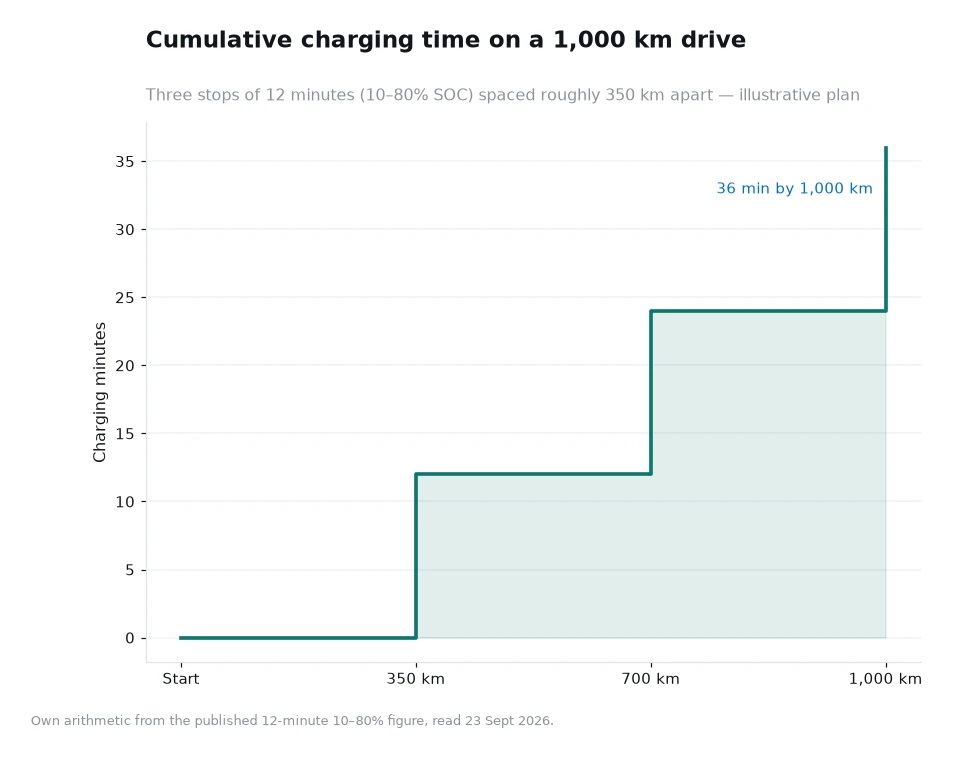
Numbers make the architecture argument clearer than adjectives, so here is an example with declared assumptions. Assume a 1,000 km drive, stops planned at roughly 350 km, 700 km and 1,000 km, and every stop held to the published 10-80% window of 12 minutes. The plan therefore spends 12 + 12 + 12 = 36 minutes charging, or three quarters of an hour across a full day on the road.
Work out what that buys in distance. Divide 1,000 km by 36 charging minutes and you get about 27.8 km of travel per minute of charging. Compare it with the driving itself: at an assumed average of 100 km/h, the day takes 10 hours, or 600 minutes, so charging is 36 divided by 600, which is 6% of the time behind the wheel. Even if each stop stretches to 20 minutes with a coffee and a walk, the total is 60 minutes out of 660, still under 10%.
Frequently asked questions
Does an 800-volt car charge faster on any public charger?
Only as fast as the charger allows. An 800V platform can accept very high power, and the published window is 10-80% in 12 minutes, but a lower-output site will simply take longer.
Is the 12-minute figure the same for the G6 and the X9?
Yes. Both published Australian models list a 10-80% state of charge window of 12 minutes, with WLTP range of up to 525 km for the New G6 and up to 580 km for the X9.
Plan the trip around charging, not around fuel
The useful exercise before a long drive is to mark the towns you would stop in anyway and check what charging exists there. With a 12-minute rapid window, the charge usually finishes before the coffee does, which is the whole point of moving to a higher-voltage platform in a country built around long highways.
If you want the source figures behind this article, the suv ev australia model pages carry the platform description, the charging windows and the warranty terms in full. Read those alongside the charging information for the connector and flap detail, then take a XPENG X9 test drive if seven seats are on your list. Between the two models, the platform question answers itself.
Platform details, range figures, charging windows and warranty terms come from the manufacturer's Australian pages, read 23 Sept 2026; WLTP range depends on conditions, the 427 km figure is from internal tests of the G6 RWD Long Range, and the trip arithmetic above is an illustrative example with assumed inputs.[1]